
Understanding Pacaya lava on a visit
Distinguish old lava rock, heat and moving molten lava. Read dated images carefully and confirm what the permitted visit can actually include.
Last reviewed October 2026
Contents9
- Pacaya lava: separate rock and heat, or moving lava
- What the past Pacaya lava record shows
- Read the photo on this page as history
- Satellite colours need their own explanation
- What to ask a seller about a lava-themed walk
- Heat activities are a separate question
- A lava field can still be the reason to visit
- How to share a lava image responsibly
- Verdict: choose Pacaya lava expectations with dates attached
Pacaya lava in a photo is not a promise of moving lava on your visit. Old flow rock, heat at a location and molten rock are distinct things. Ask what the allowed route can show on your date. Current activity has not been confirmed here, checked October 2026, so this page does not advertise a live lava display.
In brief: choose a guided landscape walk rather than a guaranteed red glow. Read image dates and the words used in the trip description. A past flow can explain the place without being a feature you can approach today.
Pacaya lava: separate rock and heat, or moving lava
Lava is molten rock that reaches the surface. Once a flow cools into rock, people may still call the resulting landform a lava flow or lava field. The name can describe its origin rather than its current state. This is one reason a listing's “lava walk” needs a clear explanation.
The USGS magma-and-lava explanation distinguishes molten rock below the surface from lava at the surface. That is a general definition. It is not evidence that a flow is present at Pacaya today. For local conditions, use a dated monitoring source.
| Term in a description | Meaning to clarify |
|---|---|
| Lava field | Rock landscape formed by earlier flows, not necessarily molten |
| Hot spot | Heat at a location; not proof of a visible moving flow |
| Incandescence | Visible glow described by an observer; read its date and context |
| Flowing lava | Molten material moving at the surface; needs a current dated report |
Scroll for more →
The terms do not form a list of visitor options. A feature can exist without being on an allowed route. Ask what is present. Then ask what visitors may do. Neither answer should be guessed from a photo.
What the past Pacaya lava record shows
The Smithsonian Pacaya profile describes lava flows as part of the volcano's eruptive history. Its latest displayed bulletin, for December 2021, reports lava-flow activity ending in mid-May of that year. We checked the profile in October 2026. That is a past report, not a current observation made by this guide.
The record also includes explosive activity. Do not treat lava as the only relevant process simply because a travel image focuses on it. The science record explains a changing volcanic system. It does not promise a fixed display for visitors.
Read the last-eruption guide for the dates and current bulletin-check limits. A catalogue's last-known-eruption field and a live route report are distinct sources of details. A past date cannot prove current quiet. Missing current evidence also cannot prove a flow is happening.
Read the photo on this page as history
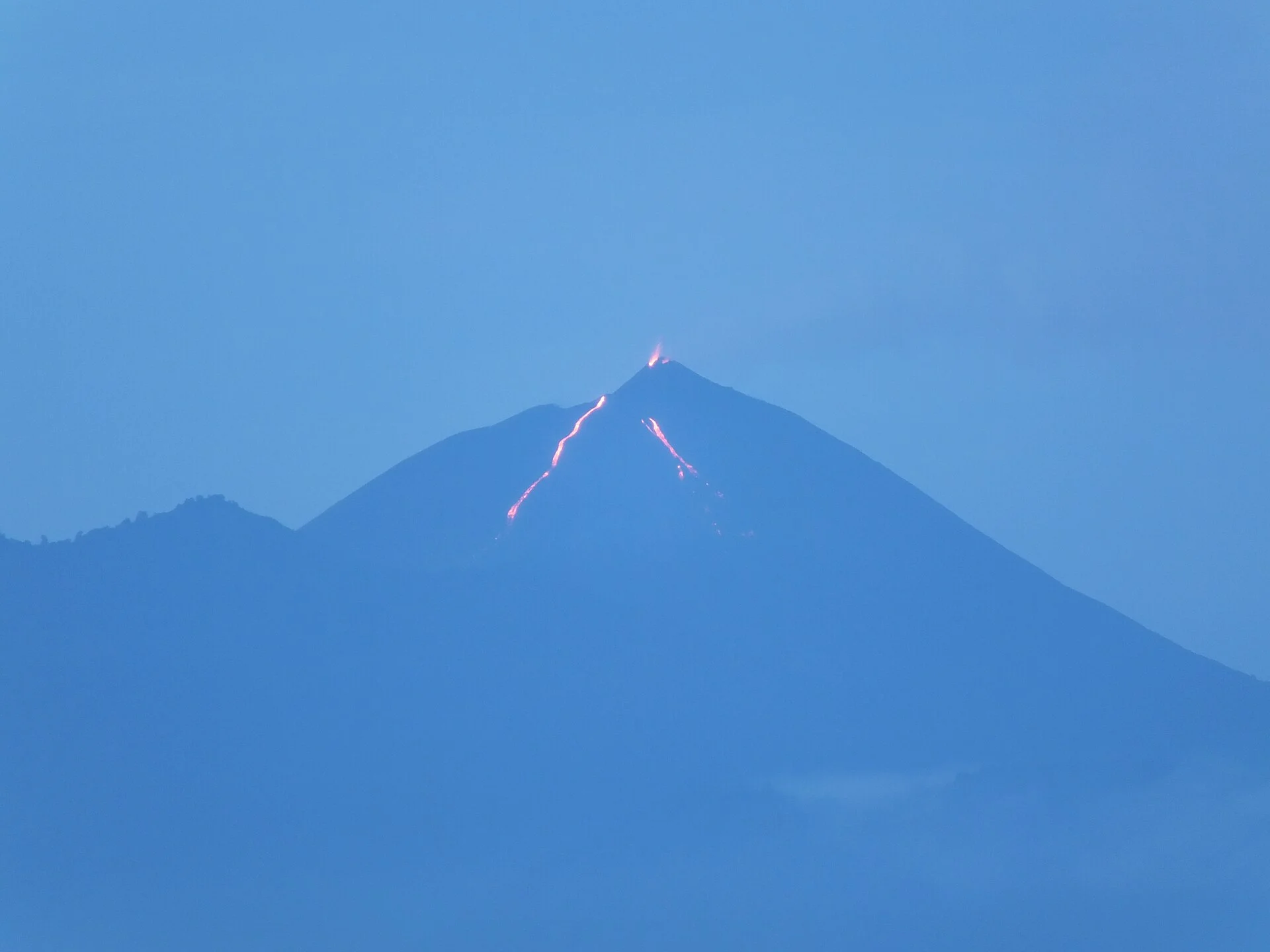
The main photo is a real view of Pacaya from Guatemala City, taken in September 2020 according to its Commons record. It documents a past view with lava activity. Its capture date is stated in the credit. It does not show what a visitor will see from a trail today.
A distant view and a close view also answer distinct questions. The camera may be outside the visitor walking area. A glow visible from the city does not tell you how close anyone was allowed to stand. Do not turn the lens position into an approach instruction.
Exposure and darkness can affect how a scene appears. A bright night image can make the glow more prominent than the surrounding landscape. It may omit the path and guide, plus other context. Ask for the actual trip plan rather than expecting a photo to explain the visit.
Satellite colours need their own explanation
NASA's Pacaya image article was published in April 2021. It explains a Landsat view captured in March of that year using shortwave-infrared details. The image treatment highlights heat in a way that differs from an ordinary ground photo. The date and processing are part of what the picture means.
A red feature in a processed satellite image should not be read as the exact colour a walker would see. Nor does the image locate a permitted viewpoint. It can show patterns useful for understanding an event at landscape scale. It is not a route map for approaching a flow.
Check the caption whenever a seller or social post shares such an image. Keep capture date separate from issue or repost date. A later website update does not change when a satellite passed over the area. The original explanation is more useful than a cropped image without its labels.
What to ask a seller about a lava-themed walk
Ask whether the trip is a walk on older lava rock or an outing advertised around a currently observed feature. Request the named allowed endpoint. If a moving flow is mentioned, ask for the dated source behind that expectation. A confident sentence without a source is still only a claim.
Find out what happens if the expected feature is not available on the allowed route. The seller should explain whether the walk changes, whether another date is offered and which terms apply. Do not assume a missing glow means a refund. Read the conditions before making it the reason for booking.
Ask which parts of the day remain included. A changed stop should not leave the guide or return unresolved. If transport and guiding are separate, make sure both know the revised plan. The hiking guide explains those handovers in more detail.
Heat activities are a separate question
Some trips advertise food prepared using heat at a guided stop. That does not establish moving lava beside the group. It also does not show that every route includes the activity. Confirm the specific service and its permitted plan.
Do not search for a hot opening or test the ground to reproduce an image. This guide does not give a method for judging temperature or approaching heat. Keep to the current route and the guide's instructions. If the advertised stop is omitted, use the agreed alternative.
An activity's availability and its ingredients are distinct checks. Someone may enjoy the walk while declining the food. Ask where that person waits and how the group continues. The visit should remain a clear guided plan for everyone.
A lava field can still be the reason to visit
You do not need a moving flow to be interested in volcanic ground. Older rock can help explain how flows build a landscape. A guide may point out features on the allowed path and connect them to the place's history. Ask what the walk is designed to help you understand.
Keep the expectations specific. A cloudy day can hide a distant view while leaving nearby ground visible. A changed route can remove one feature while preserving the larger walk. Decide which parts matter to you before choosing a format. That gives the seller a clearer question to answer.
The Pacaya overview sets out the volcanic complex and main visit choices. It helps keep the landscape separate from one promotional image. A volcano is not a scheduled display. The best match is the trip whose confirmed parts fit your interests.
How to share a lava image responsibly
Keep the photographer and source, with the date with the picture. Say whether it is a past eruption, an older field or a processed satellite view. Do not remove a caption and then present the result as today's activity. The subject can remain impressive with its real context intact.
If the image's date is not known, leave it undated rather than inventing one. Avoid using it to make a current-status claim. A place name confirms neither capture time nor access. Look for the original record before building a plan around it.
The images used in this guide have visible credits and their source records. That makes the past context easier to inspect. It does not mean the photographer assessed present visitor access. A photo and an access notice still have distinct roles.
Continue with these guides
Verdict: choose Pacaya lava expectations with dates attached
Treat Pacaya lava as several distinct subjects: older rock and heat, plus any dated report of molten movement. None is a standing promise for the next walk. Confirm the allowed route and choose a day that can remain worthwhile without a specific glow. Keep current monitoring with its own source.